Ezekiel 14 and Psalm 55

Today’s reading from Ezekiel 14 is particularly critical of the idolatry that lives in a person’s heart. It is evil to put on a facade of obeying God on the outside and loving something else more on the inside. D.A. Carson identifies this in the following paragraph:

…the peculiar expression “set up idols in their hearts,” repeated several times with minor variations in 14:1-8, reeks of duplicity. Publicly there may be a fair bit of covenantal allegiance, but heart loyalty simply isn’t there. To set up idols in the heart is to separate oneself from the living God (14:7).1

That is a harsh indictment from Ezek. 14:8 and it cause me to take inventory of my own heart. Carson goes on to say,

That danger is no less treacherous today than in Ezekiel’s time. Somehow we manage to adhere to our creedal profession, but if anything goes wrong our undisciplined rage shows that we maintain little real trust in the living God: our secret idol is comfort and physical well-being. We attend church, but rarely do we pray in private or thoughtfully read the Word of God. We sing lustily at missionary conventions, but have not shared the Gospel with anyone for years. And deep down we are more interested in our reputation, or in sex, or in holidays, than we are in basking in the awesome radiance and majesty of God. 2

I found the last section of Ezekiel 14 particularly interesting. God tells Ezekiel that even if Noah, Daniel, and Job were present in Jerusalem, judgment would still take place. (Ezek. 14:12-23)

The reasoning presupposes the theology of Genesis 18: God may spare a wicked city or nation for the sake of the just who reside there. But where wickedness overflows, not even the presence of Noah (spared from the Flood), Job (declared “blameless” and “upright,” Job 1:1), and Daniel (Ezekiel’s contemporary, serving in the Babylonian courts, renowned for his piety) will stay the disaster that God ordains.3

Psalm 55 is a beautiful and timely psalm for me this morning. Ps.55:1-3 is an expression of my heart. In my case, the enemy is Satan and his desire for my destruction.

Ps. 55:4-5 express the spiritual/emotional pain of the psalmist and Ps. 55:6-8 defines the panic of his heart. In spite of the pain and fear, the psalmist responds in faith in Ps. 55:16—“But I call to God, and the Lord will save me” and the last part of Ps. 55:23—“…But I will trust in you.”

The verse that I will carry with me today is from Psalm 55:22:

Cast your burden on the Lord
  and he will sustain you;
he will never permit
  the righteous to be moved.
 

1 D. A. Carson, For the Love of God: a Daily Companion for Discovering the Riches of God’s Word., vol. 2 (Wheaton, IL: Crossway Books, 1998), 25.

2 Ibid.,

3 Ibid.,
Ezekiel 13 and Psalm 52-54

Ezekiel 13 is divided into two parts. The first part (Ezekiel 13:1-16) is Ezekiel’s pronouncement of woe against the false prophets who instead of warning Jerusalem about the impending judgment like Jeremiah was doing, instead proclaimed that peace was coming (Ezke. 13:10). They are likened to “whitewashed walls.”

It makes me think of the many false preachers today who speak only of riches and prosperity and neglect to preach against sin and judgment. Even though each person is ultimately responsible for their own relationship to God, the wicked effect of the prosperity preachers upon people will one day face accountability with God. Carson describes them,

They are more interested in auguries, telling personal fortunes, serving as “prophetic” personal hope-spinners, than in conveying the word of the Lord. They are not really serious people—except for their seriousness when it comes to getting paid (Ezekiel 13:17-19).1

The second part of Ezekiel 13 is a pronouncment against women who use magic to foretell the future (Ezekiel 13:17-23). Ezekiel avoids calling them prophetesses. This section is a little more obscure to me, however, I think that it also refers to women who speak the things that people want to hear rather than the truth.

Psalm 52 and Psalm 53 speak about the wicked and those who deny God. I highlighted Ps. 52:1 and Ps. 52:8; both speak about the “steadfast love of God”

Psalm 54 take a bit of a turn and sings about the God who upholds my life. Ps. 54:4 and Ps. 54:7 speak about God upholding me and delivering me. These are solid promises that I can hold on to even when doubt and fear are strong.

1 D. A. Carson, For the Love of God: a Daily Companion for Discovering the Riches of God’s Word., vol. 2 (Wheaton, IL: Crossway Books, 1998), 25.

Ezekiel 12 and Psalm 51

Today’s readings are from Ezekiel 12 and Psalm 51. Ezekiel is commanded by the Lord to demonstrate the Lord’s judgment against Jerusalem by preparing an exile’s baggage and digging a hole in the wall of his home. Carson explains the event,

One can imagine the power in Ezekiel’s symbol-laden actions. In full view of the exiles, he packs his meager belongings in exactly the same way he would if he were a Jerusalemite preparing for a seven-hundred-mile march into exile. What he could bring would have to be carried on his shoulders. At night he digs through the mud-brick walls of his own house. Probably this symbolizes the futile attempt at breakout made by Zedekiah and those immediately around him (2 Kings 25:4; Jer. 39:4): they fled, but they could not escape. 1

In Ezek. 12:22, God addresses the saying among the people, “…the days grow long, and every vision comes to nothing?” Judgment is now imminent and will come to pass. This proverb will no longer be used. Carson notes,

Ezekiel and (in Jerusalem) Jeremiah keep promising the destruction of the city while years pass with its mighty walls intact. Jeremiah has been at it for decades. Doubtless God sees the long delay as powerful evidence of his forbearance and mercy, providing multiplied opportunities for repentance; the people simply grow cynical. So judgment will certainly fall, Ezekiel says—and the popular proverbs will be destroyed.2

Relating it to today, he says,

So it is not surprising that in the “last days”—the days between the first and second comings of Christ, the days in which we live—new generations of scoffers arise and make a virtue of the same wretched cynicism: “Where is this ‘coming’ he promised? Ever since our fathers died, everything goes on as it has since the beginning of creation” (2 Pet. 3:3–4). But the Flood came. And so will the fire.3

Psalm 51 is the famous song of David’s repentance of his sin with Bathsheba after he was confronted by Nathan the prophet. In Ps. 51:1-4, David pleads to God for His mercy while asking for forgiveness and both confessing and repenting of his sin. He acknowledges that his sin is first and formost against the holy God (Ps. 51:4). He confesses that he is encompassed by the grief and guilt of his sin (Ps. 51:3). David states a truth in Ps. 51:5 that is true of all of us — we are born with a sin nature (c.f. Rom. 3:23).

Psalm 51:10 is a sinner’s cry for restoration and a new start. It is continued in Psalm 51:12. He states that God is able to remove the stain of sin in Ps. 51:7. There is a plea for the mercy of God in Ps. 51:11.

The end result of restoration by God is that David will testify of the mercy and goodness of God before other sinners who may also be burdened by the guilt of their sin. They too can turn to God for forgiveness and restored fellowship with God.

Of the many, many verses that I highlighted in this psalm, the last one is Ps. 51:17. God delights when I forsake sin and return to him with my heart broken over what I am and what I have done. Even the sinner who struggles under the guilt of repeated sin (Heb. 12: ) finds forgiveness and restoration in God.

I am amazed at the inverse relationship between the two readings today. Ezekiel is full of the judgment of God against unrepentant sin by His chosen people in Jerusalem. Psalms 51 is full of repentance, mercy, forgiveness, and restoration. The question to ask myself is, “Is my heart tender and soft regarding sin in my life or is it hardening and unrepentant?”

1 D. A. Carson, For the Love of God: a Daily Companion for Discovering the Riches of God’s Word., vol. 2 (Wheaton, IL: Crossway Books, 1998), 25.

2 Ibid.,

3 Ibid. ,

Video

Ezekiel 11 and Psalm 50

Today‘s readings are from Ezekiel 11 and Psalm 50. Ezekiel 11 is a continuation of the vision of Ezekiel that began in Ezek. 8. In Ezekiel 11, the prophet sees 25 men in Jerusalem who are deciding on a course of action as a result of the pending oppression by Babylon. It also marks the change of location for the glory of God. D. A. Carson writes,

…this glory, once associated with the temple—especially with the Most Holy Place and the ark of the covenant over which the cherubim stretched their wings—abandons the temple and hovers over the mobile throne. The same mobile throne Ezekiel had seen in Babylon is now parked by the south entrance to the temple.1

There was a false sense of security for these people, because they lived in the city of Jerusalem. They thought that God would never destroy the city and fulfill His judgment. They used the metaphor of a cauldron as the wall of protection around the city and that they were like the meat inside, safe. Instead, God would take them out of safety and put them in a place where they would face judgment.

There is a ray of hope in Ezek. 11 that begins to dimly shine. Ezek. 11:14-21, God speaks through the prophet to tell of the remnant that He would restore. He would begin by giving them a new heart of flesh after removing their hearts of stone (Ezek. 11:19). This would result in a new relationship with Him (Ezek. 11:20). Carson points out the irony of the relationship of the exiles to the Jerusalemites,

The vision of chapters 8–11 ends with Ezekiel transported back to Babylon, telling the people everything he has seen and heard. The first strands of hope in this book have been laid out, but not in the categories expected. Jerusalem will be destroyed, and God’s purposes for the future center on the exiles themselves. How often in Scripture does God effect his rescue, his salvation, through the weak and the despised!2

Psalm 50 begins with the announcement that God has come to speak. He warns His people that He doesn‘t require animals sacrifices from them. He owns everything and they cannot give Him anything that He does not already have. Instead, rather, He requires their sacrifice of faithfulness and obedience.

Faithfulness and obedience – they are two of the most basic things that I can give to God yet many times I resist. If He required something more complex, I might excuse myself by noting that those things were too difficult for me to offer or accomplish. Instead, He asks for my obedience to His Word and my faithfulness – both of these are within my ability to give every day. But in a very real sense, I am unable to be obedient and I am unable to be faithful without the work of the Holy Spirit in my life. It is the Spirit Who gives me the power to obey and to remain faithful each day.

1 D. A. Carson, For the Love of God: a Daily Companion for Discovering the Riches of God’s Word., vol. 2 (Wheaton, IL: Crossway Books, 1998), 25.

2 Ibid.,

Ezekiel 10 and Psalm 49

Ezekiel 10 is the part of Ezekiel’s vision where he sees the cherubim and the glory of God leaving the Temple. The vision is much the same as his original vision in Ezek. 1:1-28. Many of the contemporary gods of his day were thought to have a range limited by space and an influence within only a specific area. God, on His chariot-throne is free to leave the temple along with His power and influence. He chose to depart the temple because of the idolatry of Israel and because she had broken the covenant.

Psalm 49 is a warning to those who are wealthy and put their trust in their possessions. No one can ransom another person’s life (Ps. 4:5-9). Both the wealthy and the poor (and those somewhere in between) will die and leave all of their possessions behind. The poor do not need to fear the wealthy and the wealthy need to fear the Lord. The message of the gospel is for all people (Ps. 49:1-2) and those with means are not sufficient in themselves and able to ignore the gospel.

As a middle-of-the-roader, I don’t think I fear the rich, but perhaps I fear their influence. Psalm 49:16 is appropriate for putting life into the proper perspective. The one we should respect and be influenced by is The Lord Almighty.

Ezekiel 9 and Psalm 48

Ezekiel 9 is a sobering passage. In his vision, Ezekiel sees God call forth the “executioners”. There are six of them – one commentary describes them as Levite guards and another as heavenly beings. Each one is equipped with a mappats (some type of war club, literally “shattering weapon”). There is also a seventh figure whose responsibility is to go throughout the population of Jerusalem and put a mark on the forehead of any of those who have not been a part of the idolatry, a righteous remnant. The executioners begin with the elders, the first group described in Ezek. 8:11.

Ezekiel falls on his face and cried out to the Lord in fear that all the people would be destroyed and there would be no remnant. This reminds me of Abraham’s cry to The Lord when God was about to destroy Sodom and Gomorrah (Gen. 18:23-33).

After much patience, God’s wrath is now spent on Jerusalem because of her disobedience and her idolatry. There is not an “if” with God’s judgment, only a “when”.

Reading this chapter this morning gave me pause to wonder how long the Lord will continue to hold back His righteous judgment on our nation. Our country is guilty of the same sins as the people of Israel and the pace of degeneration seems to be increasing every year.

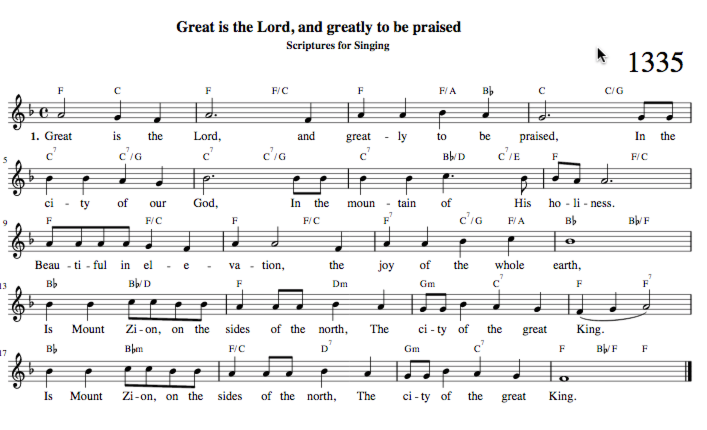
Psalm 48 opens with a praise to God. Ps. 48:1-2 is familiar to me because of the song we used to sing when I was a teenager. It comes from these verses,

Ps. 48 Song graphic

I can hear my wife beautifully singing it in my mind. The psalmist is expressing the greatness of the city, because God’s presence is there. It is God Who makes Zion a place of strength and beauty. Likewise for the believer, it is the indwelling of the Holy Spirit that makes us the temple of God today.

There are two things that are repeated again in this Psalm that caught my attention this morning. The first is the statement in Ps. 48:3, “…God has made himself know as a fortress.” God as a place of refuge is reiterated throughout the Psalms. As humans, we are extremely vulnerable and only God can provide ‘safe haven’ for our souls.

The second is Ps. 48:9 where the psalmist again talks about the ‘steadfast love’ of God. The love we receive and give to other people is subject to failure. God’s love cannot and will not fail. It is enduring and never changing. That is a precious promise for me to grasp.


Ezekiel 8 and Psalm 46-47

Ezekiel 8 begins a vision that extends through chapter 11. He see four instances of idolatry:

  1. Ezek. 8:3-6 he sees the idol that provokes God to jealousy. The king is complicit and rather than lead the people in faithfulness, he leads them in compromise.
  2. Ezek. 8:7-13 he sees the seventy elders unclean creatures.
  3. Ezek. 8:14-15 he sees women engaged with a fertility cult.
  4. Ezek. 8:16 he sees the priests with their backs to the temple worshiping the sun.

D. A. Carson responds to these events:

Modern forms of idolatry are different, of course. Most of us have not been caught mourning for Tammuz. But do our hearts pursue things that rightly make God jealous? Do we love dirty and forbidden things? Do we ascribe success to everything but God? We may not succumb to fertility cults, but doesn’t our culture make sex itself a god? 1

Psalm 46 opens with,

God is our refuge and strength, a very present help in trouble.

Therefore we will not fear …

It is reason enough that God is a place of safety and security. When we run to Him, we do not need to fear. Allen P. Ross writes,

The psalmist declared that God is the Refuge (mahseh, “shelter from danger”; cf. comments on 14:6) and Strength (cf. comments on 18:1) of believers. In other words they find safety and courage by trusting in Him, who is always present to help them (see comments on 30:10) in their troubles. So the saints need not fear, even if many perils come against them. The language is hyperbolic, to describe how great the perils may be that could come. No matter what happens, those trusting in Him are safe. 2

Ps. 46:7 again speaks of God as a “fortress”. It is repeated in Ps. 46:11. When the world experiences the wrath of God, believers are safe inside the might fortress of God. This is the same place of protection that Martin Luther penned about in his hymn, A Might Fortress is Our God,

A mighty fortress is our God,
a bulwark never failing;
our helper he amid the flood
of mortal ills prevailing.
For still our ancient foe
doth seek to work us woe;
his craft and power are great,
and armed with cruel hate,
on earth is not his equal. 3

1 D. A. Carson, For the Love of God: a Daily Companion for Discovering the Riches of God’s Word., vol. 2 (Wheaton, IL: Crossway Books, 1998), 25.

2 Allen P. Ross, “Psalms,” in The Bible Knowledge Commentary: An Exposition of the Scriptures, ed. J. F. Walvoord and R. B. Zuck, vol. 1 (Wheaton, IL: Victor Books, 1985), 828.

3 Martin Luther, “A Mighty Fortress Is Our God” (No. 75) in The Brethren Hymnal (Elgin, IL: House of the Church of the Brethren, 1951).

Ezekiel 7 and Psalm 45

Ezekiel 7 was a bit of a struggle reading this morning. Nothing seems to have jumped out at me and I was unable to find anything in the companion commentaries that I read.

However, one thing that did catch my eye this morning was in The Bible Knowledge Commentary regarding a shift in attitude by those in Jerusalem:

Ezekiel 7:19–20. In addition to lamenting their loss the people would remove the obstacles that had caused it (Ezek. 19–22). They would throw their silver into the streets, and their gold would be an unclean thing. Also their idols made from the metal of their jewelry would be an unclean thing, so items once deemed precious would be discarded. …

Why would the people suddenly loathe their material wealth? One reason was the inability of silver and gold to buy the security for which it was originally amassed. It would not be able to save them. …1

Material things tend to lose their grip when we are consumed by God in either judgment, chastening, or trials. Another good verse that comes to my mind is Philippians 3:8 where Paul compares all things to rubbish in comparison to gaining Christ.

Psalm 45 is a song celebrating the marriage of the king. Ps.45:6 is a good verse to highlight and it reminds me that my King is King forever.

1 Charles H. Dyer, “Ezekiel,” in The Bible Knowledge Commentary: An Exposition of the Scriptures, ed. J. F. Walvoord and R. B. Zuck, vol. 1 (Wheaton, IL: Victor Books, 1985), 1241.

Ezekiel 6 and Psalm 44

In Ezekiel 6, God tells Ezekiel to set his face toward the mountains. The significance of the mountains is likely the high places of idol worship in Israel. The following is a description from The Bible Knowledge Commentary:

High places were in Canaan before Israel arrived, and God commanded Israel to destroy them (Num. 33:52). …After the temple in Jerusalem was completed, worshiping at high places was once again discouraged. Most high places remaining in the land were dedicated to false gods (1 Kings 11:7–10). 1

Ezekiel’s actions and condemnation would surely ring clear in the minds of the exiles as they remembered the rampant idolatry that occurred in the land prior to its destruction and judgment.
In Ezekiel 6:13-14, the pronouncement of Ezekiel 6:17 is repeated. The Bible Knowledge Commentary describes these verses:

The imagery in verses 1–7 was repeated here as God promised He would slay the people … among … their altars, on every high hill and … under every spreading tree and every leafy oak. Often on the high places where altars were built were luxuriant trees, which represented growth and possibly fertility (cf. Hosea 4:13). The “oak” (’ēlâh) was the terebinth tree. It is a deciduous tree common to Palestine and grows to a height of 35–40 feet. The Elah Valley, where David slew Goliath, probably received its name because of the abundance of these trees (1 Sam. 17:2, 19).

God had given Israel a land luxurious with “spreading” trees and “leafy” oaks, but the people corrupted His gift, using these displays of His bounty as places to offer fragrant incense to all their idols. Therefore God would reduce their rich land to rubble—a desolate waste from the desert to Diblah. (Dyer, 2)

These current times are full of idolatry. From greed to covetousness to the prosperity gospel, my generation is seeking for a god in all of the wrong places while vehemently denying the true God.

Psalm 44 is definitely a change from many of the previous Psalms which have been filled with hope or testimonies of God’s faithfulness. Ps. 44 instead appears to be a question of why God appears to ignore those who are trying to follow Him. I found some helpful insight from D. A. Carson’s For the Lord of God Volume Two:

At least two hints toward the end of the psalm, though they do not provide “solutions,” invite the reader to reflect on the direction taken by later biblical writers. (1) Sometimes God’s apparent sleep, his withdrawal (44:23ff.), is not overt wrath poured out on our sin, but his own timing. He refuses to be hurried, and his “unfailing love” (44:26) will triumph in the end. The ebbs and flows of Christian history support the same stance: they do not always correspond with differing degrees of loyalty or different methods. As one commentator (F. D. Kidner) has finely put it, “Although its picture of the sleeping Lord may seem naive to us, it was acted out in the New Testament, to teach a lesson which we still find relevant: cf. verse 23 with Mark 4:38.” (2) More stunningly, the psalmist says it is “for your sake [that] we face death all day long” (44:22, italics added). That point is not fully developed until Paul quotes the verse (Rom. 8:36ff.). But already it embraces the notion that some suffering is not the result of our sin but simply the result of being faithful to God in a world at war with him. In such cases suffering is not a sign of defeat but a badge of fidelity and fellowship, even of victory: we are “more than conquerors through him who loved us” (Rom. 8:37). 3

1 Dyer, Charles H. “Ezekiel.” The Bible Knowledge Commentary: An Exposition of the Scriptures. Ed. J. F. Walvoord and R. B. Zuck. Vol. 1. Wheaton, IL: Victor Books, 1985. 1238. Print.

3 Carson, D. A. For the Love of God: a Daily Companion for Discovering the Riches of God’s Word. Vol. 2. Wheaton, IL: Crossway Books, 1998. Print.

Ezekiel 5 and Psalms 42-43

In Ezekiel 5, Ezekiel is again commanded to provide a physical illustration to the exiles of what is going to happen to Jerusalem. Remembering back a few days, the exiles did not or would not believe in the judgment against Jerusalem. In this case, Ezekiel shaves off all of his hair and beard and uses portions of it to demonstrate the various aspects of the judgment against Jerusalem. Ezekiel 5:12 provides the summary of the judgment: one third will die within the city from the siege, a third will die by the sword in the final breakout, and a third will be scattered into Exile.

The pronoun “I” is repeated throughout Ezekiel 5:8-17 and emphasizes the unstoppable hand of God’s wrath. Ezekiel 5:13 says that His wrath will eventually subside and His anger will cease. God’s wrath is not fully resolved until the sacrifice of Jesus on the cross. (Rom. 3:20-26).

Psalm 42 and Psalm 43 are songs for the downcast heart. The phrase, “Why are you cast down, O my soul, and why are you in turmoil within me? Hope in God…” is repeated three times in Ps. 42:5, Ps. 42:11, and Ps. 43:5. It may sound simplistic, but the solution to a downcast heart or depression, is hope in God. He is the source of joy and the antidote to depression.

Another relevant phrase  in Psalms 43:3 is, “Send out your light and your truth; let them lead me;” When confusion and fear step into my life, it is the truth and light of the Word of God that I need most in my life. Truth dispels darkness as light does. Fear grows in the absence of truth. Fear tells me God doesn’t care and I am all alone. Truth reminds me of His promises and gives hope for His presence and love.

I close with a beloved verse in Ps. 42:1, “As a deer pants for flowing streams, so pants my soul for you, O God.” Just as a deer needs fresh water so my soul needs the living water from the Word of God to sustain my spiritual life.

Matthew Henry explains this verse effectively:

When he (David) was debarred from his outward opportunities of waiting on God, when he was banished to the land of Jordan, a great way off from the courts of God’s house. Note, sometimes God teaches us effectually to know the worth of mercies by the want of them, and whets our appetite for the means of grace by cutting us short in those means. We are apt to loathe that manna, when we have plenty of it, which will be very precious to us if ever we come to know the scarcity of it. 1

1 Henry, Matthew. Matthew Henry’s Commentary on the Whole Bible: Complete and Unabridged in One Volume. Peabody: Hendrickson, 1994. Print.